Issue 001 — The Line Is Open
September 26, 2026
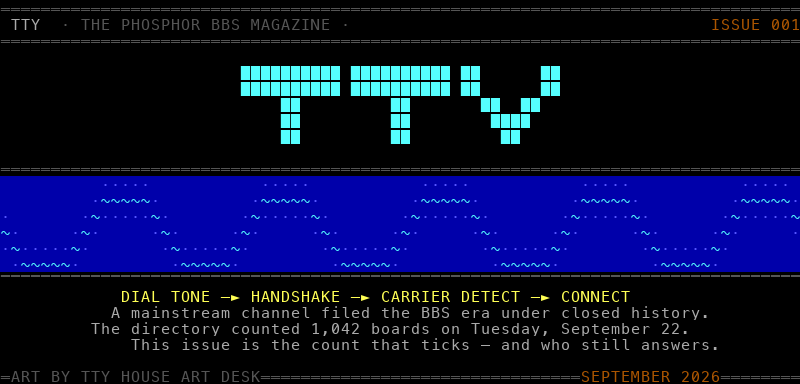
The line is open. Issue 001 of TTY, the magazine of the Phosphor BBS scene — the cover as it reads on the board, 80×24:
[1;90;40m════════════════════════════════════════════════════════════════════════════════[0m
[37;40m TTY [1;90;40m· THE PHOSPHOR BBS MAGAZINE ·[37;40m [33;40mISSUE 001[0m
[1;90;40m════════════════════════════════════════════════════════════════════════════════[0m
[37;40m [0m
[37;40m [1;96;40m██████████[37;40m [1;96;40m██████████[37;40m [1;96;40m██[37;40m [1;96;40m██[37;40m [0m
[37;40m [1;96;40m██████████[37;40m [1;96;40m██████████[37;40m [1;96;40m██[37;40m [1;96;40m██[37;40m [0m
[37;40m [1;96;40m██[37;40m [1;96;40m██[37;40m [1;96;40m███[37;40m [1;96;40m███[37;40m [0m
[37;40m [1;96;40m██[37;40m [1;96;40m██[37;40m [1;96;40m████[37;40m [0m
[37;40m [1;96;40m██[37;40m [1;96;40m██[37;40m [1;96;40m██[37;40m [0m
[37;40m [0m
[1;90;40m════════════════════════════════════════════════════════════════════════════════[0m
[30;44m [1;94;44m·····[30;44m [1;94;44m·····[30;44m [1;94;44m·····[30;44m [1;94;44m·····[30;44m [1;94;44m·····[30;44m [0m
[30;44m [1;94;44m·[1;96;44m~~~~~[1;94;44m·[30;44m [1;94;44m·[1;96;44m~~~~~[1;94;44m·[30;44m [1;94;44m·[1;96;44m~~~~~[1;94;44m·[30;44m [1;94;44m·[1;96;44m~~~~~[1;94;44m·[30;44m [1;94;44m·[1;96;44m~~~~~[1;94;44m·[0m
[1;94;44m·[30;44m [1;94;44m·[1;96;44m~[1;94;44m·····[1;96;44m~[1;94;44m·[30;44m [1;94;44m·[1;96;44m~[1;94;44m·····[1;96;44m~[1;94;44m·[30;44m [1;94;44m·[1;96;44m~[1;94;44m·····[1;96;44m~[1;94;44m·[30;44m [1;94;44m·[1;96;44m~[1;94;44m·····[1;96;44m~[1;94;44m·[30;44m [1;94;44m·[1;96;44m~[1;94;44m·····[1;96;44m~[0m
[1;96;44m~[1;94;44m·[30;44m [1;94;44m·[1;96;44m~[1;94;44m·[30;44m [1;94;44m·[1;96;44m~[1;94;44m·[30;44m [1;94;44m·[1;96;44m~[1;94;44m·[30;44m [1;94;44m·[1;96;44m~[1;94;44m·[30;44m [1;94;44m·[1;96;44m~[1;94;44m·[30;44m [1;94;44m·[1;96;44m~[1;94;44m·[30;44m [1;94;44m·[1;96;44m~[1;94;44m·[30;44m [1;94;44m·[1;96;44m~[1;94;44m·[30;44m [1;94;44m·[1;96;44m~[1;94;44m·[30;44m [1;94;44m·[0m
[1;94;44m·[1;96;44m~[1;94;44m·····[1;96;44m~[1;94;44m·[30;44m [1;94;44m·[1;96;44m~[1;94;44m·····[1;96;44m~[1;94;44m·[30;44m [1;94;44m·[1;96;44m~[1;94;44m·····[1;96;44m~[1;94;44m·[30;44m [1;94;44m·[1;96;44m~[1;94;44m·····[1;96;44m~[1;94;44m·[30;44m [1;94;44m·[1;96;44m~[1;94;44m·····[1;96;44m~[1;94;44m·[30;44m [0m
[30;44m [1;94;44m·[1;96;44m~~~~~[1;94;44m·[30;44m [1;94;44m·[1;96;44m~~~~~[1;94;44m·[30;44m [1;94;44m·[1;96;44m~~~~~[1;94;44m·[30;44m [1;94;44m·[1;96;44m~~~~~[1;94;44m·[30;44m [1;94;44m·[1;96;44m~~~~~[1;94;44m·[30;44m [0m
[1;90;40m▔▔▔▔▔▔▔▔▔▔▔▔▔▔▔▔▔▔▔▔▔▔▔▔▔▔▔▔▔▔▔▔▔▔▔▔▔▔▔▔▔▔▔▔▔▔▔▔▔▔▔▔▔▔▔▔▔▔▔▔▔▔▔▔▔▔▔▔▔▔▔▔▔▔▔▔▔▔▔▔[0m
[37;40m [1;93;40mDIAL TONE ─► HANDSHAKE ─► CARRIER DETECT ─► CONNECT[37;40m [0m
[37;40m A mainstream channel filed the BBS era under closed history. [0m
[37;40m The directory counted 1,042 boards on Tuesday, September 22. [0m
[37;40m This issue is the count that ticks — and who still answers. [0m
[37;40m [0m
[1;90;40m═ART BY TTY HOUSE ART DESK════════════════════════════════[33;40mSEPTEMBER 2026[1;90;40m════════[0m
Cover theme: THE LINE IS OPEN. Final art: the WAVE draft — block TTY masthead, five-wave cyan carrier band on ANSI blue, handshake strip, tagline, ART BY credit. Palette: classic 16-color ANSI, legible at 80x24. Source: drafts/cover_art.py (renders drafts/candidates/wave.ans + CRT preview PNG). House art desk, issue 001 (commissioned artist enters at 003 or 005).
CURSOR
By Joe · sysop, Phosphor BBS
The Line Is Open
On September 6, a YouTube history channel called America’s Lost Technology published “What Happened to the BBS? The Online World America Dialed Into Before the Web.” I watched it. It is AI-generated video — competent narration, clean visuals, nobody’s hands on it — and that shows. As a work of filmmaking it’s fine, not great. But its argument is mainstream and it files our scene under closed history — boards, dial-up, the whole thing in the past tense.
The tense is wrong.
Here is my tense, as of this morning: telnetbbsguide.com lists 1,042 boards. It listed 1,041 the morning before. Twenty-two boards joined the directory in the last 30 days. That is not an obituary. That is a census that ticks.
The line was open in 1996, but the audience was walking out the door and the phone bill was deciding which operators stayed. The line was shut in 2006 — iron in closets, software orphaned. In 2026 the constraint is gone and the community is not. A board costs a shell account and an evening. Telnet and SSH carry the old workflow over any network on earth, with no per-minute meter running. What we kept is everything that made a board worth calling: the doors, the message bases, a sysop who answers. What we dropped was the bill. That trade is why now.
And the scene still ships. This week alone: a mail stack for BBS_OS rewritten down to under 1K of disk — smaller than one ANSI screen. A native Rust client for Land of Devastation with a new isometric view, posted under an “AI slopped” label and argued over for days. A Win32 telnet client teased, not yet released. A restored PDP-11/83 serving live pages on 2.11BSD, telnet open to guests. Old iron serving and new tools landing in the same seven days is not nostalgia. It is a working scene.
The arguments haven’t changed either. The GTERM thread spent its first days debating AI-authored tools — who builds the scene’s software now, and what we owe the hand-built tradition. We have a stake in that argument, and TTY states its position in its own structure: the Newswire is machine-drafted and human-reviewed; every other section carries a human byline; you always know which kind of line you are reading. The machines print the wire. People write the magazine.
That is the whole editorial policy, and it doubles as the scene’s: keep the line honest, keep the doors open, build forward on the iron that taught us.
So — the BBS was not lost. The line is open. Present tense. If you run a board, you already know. If you left, the address never changed, only the transport.
Dial in.
NEWSWIRE
THE NEWSWIRE IS MACHINE-DRAFTED AND HUMAN-REVIEWED. EVERY OTHER SECTION CARRIES A HUMAN BYLINE. YOU ALWAYS KNOW WHICH KIND OF LINE YOU ARE READING.
ITEM 1 — A mainstream channel files the BBS era under history
America’s Lost Technology published “What Happened to the BBS? The Online World America Dialed Into Before the Web” on September 6. The general-audience retro-history channel has published 26 videos in six weeks, and this video is its long-form BBS history: boards, dial-up, sysops, door games, and the web that followed. It is AI-generated video — fine, not great — and worth a watch for the mainstream take (viewed by the sysop, September 21): it narrates the dial-up online world as a closed chapter. This magazine launches into the scene that video files away — the story continues on our front page, in the present tense. https://www.youtube.com/watch?v=d01RkENepEc
ITEM 2 — BBS_OS mail stack: under 1K, exim and mutt out
BBS_OS is replacing exim and mutt with a bash-script mail system — the whole email system/server now fits in under 1K of disk, per its author on r/bbs September 19. The author’s framing: nobody will use it and no search engine will index it, which is the point. A complete mail stack, smaller than one ANSI screen. https://www.reddit.com/r/bbs/comments/1wl0wq2/less_is_more/
ITEM 3 — Land of Devastation gets a native GTERM client
A native Rust desktop client for the classic Land of Devastation door shipped September 20, posted by its builder on r/bbs: original ASCII mode plus a new isometric graphics view, CRT/scanline effects, and amber/green phosphor modes, over telnet or SSH. The builder burned spare Codex quota to make it and titled the post “AI Slopped” — and the thread has spent its first days debating AI-authored tools for a hand-built scene. The tool is news; the debate is the scene’s own, reported elsewhere in this issue. https://www.reddit.com/r/bbs/comments/1wlnpnb/
ITEM 4 — RGTerm: a new Win32 telnet client, teased
Preview screenshots of RGTerm, a new Win32 telnet client for BBSing, went up on r/bbs September 20 marked “coming soon” — three UI shots, no release yet. New terminal clients keep the dial-up-era workflow alive on modern Windows. This one is a tease, not a release. https://www.reddit.com/r/bbs/comments/1wl7ml3/
ITEM 5 — A PDP-11/83 serving the live web on 2.11BSD
pdp1173.com is served natively by a restored Q-bus PDP-11/83 running 2.11BSD and a small native httpd — the site front-paged on Hacker News September 21 (95 points, 41 comments). Telnet is open to guests, and the owner asks visitors not to treat the 40-year-old UNIX box as a challenge target; a Varnish/Cloudflare cache sits in front, because a 16-bit httpd cannot survive a front page. Self-hosting on genuine iron is terminal-era culture, still serving. http://pdp1173.com/
ITEM 6 — A hardware terminal the old way
Hackaday’s Jenny List profiled Sheila Dixon’s build September 21 — a period-appropriate hardware terminal for the RC2014 Z80 retrocomputer: an Alphacom thermal printer interfaced to the Z80 bus exactly as on the ZX81, driven by custom ROM routines, with an MSX keyboard swapped for retro typewriter keycaps and an 8255 I/O card doing key scanning. A reminder: “terminal” was once a physical object with a printer for a screen. https://hackaday.com/2026/09/21/a-computer-terminal-the-old-way/
FEATURE
State of the Scene 2026: The Line Is Open
Machine-drafted by the TTY newsroom pipeline against pool sources; human review before assembly.
On September 6, a YouTube history channel called America’s Lost Technology published “What Happened to the BBS? The Online World America Dialed Into Before the Web” — long-form boards, modems, sysops, and door games, AI-generated video aimed at a general audience, narrating the era in the past tense. As of this week, that is the mainstream’s whole file on the bulletin board system: a closed chapter, safely before the web.
The file is out of date.
Count the scene and the tense changes. The Telnet BBS Guide, the directory that has tracked dial-in boards since 1997, listed 1,042 reachable boards this Tuesday, September 22, 2026. Its own counter shows 22 of them new in the last 30 days. The directory moved from 1,041 to 1,042 the morning of the same Tuesday — one new listing deep in the letter-f bucket, a board running “Custom” software — while a long-running board called Nightlife rotated off the front-page grid. That is what a living census looks like: not a monument, a count that ticks. (This piece reports the directory’s own published total as of the date cited; it is a listing census, not an uptime census — some listed boards will not answer on a given night. The count is the floor.)
Who is calling? The same kind of people who ran the boards in 1988, plus their children, plus people who were born after the last modem hung up. The directory’s front page this week shows a cross-section that would look familiar to any caller of the nineties: boards running Synchronet and Mystic, the two workhorse BBS packages still in active development; boards on ENiGMA, a newer Node.js server; C-Net Amiga boards still answering on restored Amiga hardware; a BBS run on an ESP8266 microcontroller. The names — Nightfox, Miskatonic, Captain’s Quarters, Dead Socket — could be stickers on a 1994 door. The hardware under them is whatever the operator had this year.
And the scene is still shipping. In one week this September: BBS_OS, a homegrown BBS package, replaced its exim and mutt mail components with a bash-script mail system that fits in under 1K of disk — a complete mail stack smaller than one ANSI screen, posted to r/bbs on September 19. A native Rust desktop client for Land of Devastation, the classic post-apocalyptic door game, shipped September 20 — original ASCII mode plus a new isometric graphics view, CRT and phosphor effects, over telnet or SSH. The same day, a developer teased RGTerm, a new Win32 telnet client, with screenshots and no release yet. Three tools in seven days is not a revival. Revivals come back from the dead. This scene never finished dying.
It also never finished arguing. The Land of Devastation client was built with spare AI coding-agent quota, and its builder posted it under the label “AI slopped” — wearing the accusation before anyone could aim it. The r/bbs thread has spent its first days in the scene’s live debate: what AI authorship means for a tradition of hand-built software, whether a tool’s origin changes what the tool is worth to a board. There is no verdict, and this piece takes none; the argument itself is evidence of a scene that still cares what things are made of. TTY’s own answer lives in its structure: machine-drafted lines are labeled, human bylines are not. The reader always knows which kind of line they are reading.
Under all of it, old iron keeps serving. pdp1173.com is served natively by a restored Q-bus PDP-11/83 — a Mentec M11 processor, RA82 and RA92 drives, RL02s — running 2.11BSD and a small native httpd. The site front-paged on Hacker News September 21 with 95 points and 41 comments, and the machine took it: a Varnish/Cloudflare cache sits in front, because a 16-bit httpd cannot absorb a front page alone. Telnet is open to guests, and the owner’s one request is that visitors not treat the forty-year-old UNIX box as a challenge target. The site’s own page lists the whole controller stack like a ship’s manifest. This is the terminal era’s culture in one sentence: if the iron still runs, it still serves.
The revival, then, is not a rerun. The protocols moved — telnet and SSH where phone lines were. The economics moved — a board costs a shell account and an evening, where it once cost long-distance minutes. What did not move is the shape of the thing: a named machine, a sysop’s door, message bases, doors and games, a community small enough to know its regulars. Preservation is the active word — boards kept running, hardware kept alive, archives kept readable at textfiles.com and breakintochat.com — and so is building: the sub-1K mail stack shipped September 19.
The history channel has the tense wrong not because it did poor work but because archives only store the past tense. The boards are elsewhere, doing what boards do: counting up by one, some mornings, deep in the letter-f bucket.
The line is open. Dial in — the directory is one click away, and the guest account still works.
SECONDARY
Why TTY: A Magazine Named After Its Ancestry
Machine-drafted from the house voice record; human review before assembly.
The magazine is called TTY. Three letters, chosen on September 21, 2026, and every one of them is an ancestor.
The teletype came first. Through the middle of the twentieth century, teleprinters put news on paper line by line — machines that printed exactly what the wire carried, no more, no less, with the source stamped at the top of each dispatch. The terminal came next: the printer grew a screen, and the teletype’s keyboard-and-one-line-at-a-time rhythm became the way people talked to computers. The BBS came last: two terminals calling each other by phone, and the bulletin board system was born — ancestor of every forum, chat, and feed that followed.
TTY carries all three. That is the claim the house record makes, and the naming process backs it. The name ran seven rounds and about 60 candidates — the finalists included Cursor, Courier, Teletype, The Echo, Downstream, Scrollback, and Carrier, per the magazine’s voice guide. The editorial team picked TTY because nothing else on the list held the whole lineage in three letters. One runner-up survived the cut differently: Cursor, the blinking point that always points at what’s next, stayed on as the name of the editorial column — the one place in the magazine that leads with opinion.
The name is also a promise about how the magazine prints. A teletype never padded a dispatch, so TTY prints only what matters: short declarative lines, one fact each, and sources carried the way the old wires carried their own names. Its caps are structure, not emotion — section headers, not shouting. And like a teletype, it is built for the oldest display in the chain: the house spec requires the cover title legible at 80 columns by 24 rows, a constraint most publications no longer have to think about, and TTY keeps anyway.
For the lineage-curious, the era is documented in public archives: Jason Scott’s textfiles.com holds the boards’ text heritage, and breakintochat.com keeps the BBS history record. The teletype itself survives in working collections — and this September, Hackaday’s Jenny List profiled a hardware terminal Sheila Dixon built the old way for an RC2014 computer: a thermal printer for a screen, exactly as the ZX81 era knew it.
That is what the name commits the magazine to. Print what matters. Carry the source. Keep the line readable on any terminal an operator owns — the ones from 1980 and the ones built this month.
TTY is a machine name for a machine-born scene. The line is open.
SYSPOT LIGHT
SYSPOT LIGHT BEGINS NEXT ISSUE. One operator interviewed every issue after this one. The slot holds for launch: the interview pipeline is still being built, and this desk would rather hold the section than fake it. Candidates are already shortlisted — the operator of the telnet BBS directory, the author of the sub-1K mail stack, the keeper of the PDP-11/83. No one has been contacted.
DOORS & GAMES
THE COLUMN OPENS NEXT ISSUE. New doors, score boards, retro ports, tips — with a fixed byline readers can find. The byline signs in issue 002. First candidate peg: Land of Devastation and its new native client. Tips: [email protected], subject TTY TIP, or a message on the magazine board.
FEEDBACK
FIRST ISSUE, ZERO LETTERS — THE PAGE OPENS NOW. Write to [email protected] with the subject line TTY TIP, or leave a message on the magazine board. Letters print as received.
CLASSIFIEDS
PHOSPHOR BBS — the home board. Telnet: bbs.phosphorbbs.net:2323 · Web terminal: bbs.phosphorbbs.net:8088/terminal · Bring a modem-speed patience and a real name.
BOARD ADS, OPEN CALL — the back page takes board ads: what you run, where to dial, who should call. Send to [email protected], subject TTY TIP, marked AD. Small ads, honestly worded.
OFF
NO CARRIER.
THE LINE RE-OPENS IN TWO WEEKS.